Zero-click search means the result page answers the question and nobody visits your site, which quietly breaks the report your agency has been sending you. Here are eight questions to take into your next review, each with the answer that should satisfy you and the answer that should worry you.
What is zero-click search, and why does it matter for digital marketing agencies?
Choosing what to ask your ad agency in the era of zero-click search means rethinking how marketing performance is judged. Rankings, impressions, and website traffic are no longer enough, because AI-powered search systems answer questions directly and the searcher never clicks.
The industry is shifting from click-based visibility toward AI-driven influence. AI search engines summarize information, recommend brands, and guide decisions before anyone visits a webpage. So businesses have to start asking agencies how they improve AI search visibility, write for conversational search, and get included in zero click searches. The longer argument is in our post on brand visibility versus website traffic.
Zero click searches are searches where the answer appears in the results themselves and the user never clicks through to a website. So agencies cannot only optimize rankings. They also have to be visible and interpretable to the AI. It is less about winning on traffic and more about winning inside AI search ecosystems.
That means writing so the AI can interpret the meaning and the purpose behind the page easily. Conventional agencies were obsessed with impressions and clicks. Modern AI agencies concentrate on visibility inside AI search ecosystems instead.
Why traditional questions for ad agencies no longer work in the AI search era
The questions businesses have traditionally asked when hiring an advertising agency are less useful now, because they measure the wrong things and say nothing about visibility created by artificial intelligence. Rankings, impressions, and traffic cannot measure AI visibility, and they can contradict it: your traffic keeps growing while your power in AI-driven search drains away.
In that situation you stay exposed in search engines and become invisible in the AI summaries most people now base decisions on. The difference worth naming is between exposure and influence. Exposure is the placement of your content. Influence is your content being extracted, summarized, and recommended by the AI system. Overlook that distinction and you keep choosing agencies on indicators that are quietly deteriorating.
How AI search and zero-click results are changing digital marketing agencies
AI search and zero-click results are reshaping the agency landscape. The work shifts from generating traffic to optimizing for AI visibility and for content that matches intent. It will keep shifting, because AI systems keep changing how they read user interaction, search intention, and context. An agency cannot rely on a static SEO campaign aimed at click-through rate anymore.
Other measures have to be in place to stay ahead of conversational terms in AI search results. The agency's role moves from campaign management to optimization, and it now includes watching how content is used, processed, analyzed, and presented inside an AI response. Platforms increasingly reward content that keeps people in place rather than sending them out, the same trade in a different room.
What questions should you ask your ad agency about AI search visibility?
Ask questions that show whether an agency understands AI search visibility, conversational search behavior, and zero-click marketing. You are assessing readiness for what is coming, not only traditional marketing capability. Agencies are now judged on how well they position brands inside AI-generated answers and conversational search experiences, not only on the traffic they produce.
These eight are for the agency you already have, in the review you already run; failing one does not mean your agency is bad at their job, since much of this is new.
1. How do you optimize content for AI search visibility?
The agency should explain how it structures content for AI-generated summaries, conversational search results, and zero-click recommendation systems. That means semantic clarity, structured formatting, contextual depth, and intent alignment, all of which raise the odds of being included in an AI answer. They should also be able to explain how they optimize for natural language processing, entity recognition, and conversational query interpretation. Start here, because this question tests whether an engine can read your page at all.
A real answer sounds like this. They talk about structure: the question answered in the opening lines, headings that match how buyers ask, the products you want to be known for named plainly, and markup that tells a machine what the page is. Our guide to optimizing for Google AI Overviews is a fair standard.
The answer that should worry you. "We publish more, and at higher quality." Quality with no definition is a preference. If the shape of the page never changes, how an engine reads it never changes.
2. How do you measure marketing performance beyond traffic?
The agency should assess engagement quality, AI visibility, brand influence, and interactions by decision stage rather than concentrating on clicks and rankings. AI ecosystems shape consumer behavior before anyone reaches a website. So ask how AI mentions and visibility are measured.
A real answer sounds like this. They name a metric and say how it is collected. Something close to: we run a fixed set of your buyer questions through the answer engines on a schedule, record whether you were cited, named, or absent, and report that as a share against named competitors. Our guide to brand mention tracking lays out the shape of that measurement.
The answer that should worry you. A screenshot. One ChatGPT answer, captured once, in which your brand happened to appear. Answer engines do not return the same text twice, so a single capture is an anecdote.
3. How do you adapt content for conversational search queries?
The agency should produce clear, context-rich, intent-aligned content for natural language searches and AI interpretation. Users now ask questions conversationally inside AI search systems rather than typing keywords. Check whether the agency builds content around real user intent, question-based structures, and contextual relevance an AI can interpret and summarize. This question tests the form they write in.
A real answer sounds like this. They have your buyers' questions written down as full sentences, with the follow-ups that come after them, and pages built to answer those directly. They can tell you which of those questions you answer today and which you do not. We wrote about that shift in answering questions instead of chasing keywords.
The answer that should worry you. A keyword list with question words bolted on the front. "How to" plus a head term is not a buyer question, and a page built from one reads like it.
4. What data systems guide your marketing strategy?
The agency should use behavioral analytics, AI-driven performance monitoring, and adaptive optimization to keep refining campaigns. Ask how they collect data, read search behavior, and adjust as AI search trends change. An agency ready for zero-click work should combine performance analytics with real-time optimization instead of static reporting. Question three asked what they write. This one asks where the instruction to write it came from.
A real answer sounds like this. They can name each source and say how often it is read. Search Console, where impressions and clicks are reported as separate numbers. Server logs, where AI crawlers identify themselves; OpenAI publishes the names and address ranges of its crawlers, and reading those visits out of your own analytics is a job anyone can do. Then their own scheduled sampling of the engines.
The answer that should worry you. A dashboard nobody opens between reports, or "our experience in your sector." Experience is worth having. It is not a data system.
5. How do you respond to changes in AI search algorithms?
The agency should be flexible enough to change strategy as AI technology advances and user search behavior moves with it. AI search engines keep improving, so flexibility matters more than sticking to a traditional SEO approach. This question asks how the agency notices a change, and what it does next.
A real answer sounds like this. They sample repeatedly rather than checking once, because answers vary between runs and between locations. They separate a real change from ordinary variation before anyone acts on it. They also read what the platforms publish, and Google keeps its own guidance on how sites appear in AI features in Search.
The answer that should worry you. "Nothing has really changed, we keep doing what works." Or the opposite, a rebuilt plan every time a single answer moves. Neither is a method.
6. How do you improve brand authority in AI search results?
The agency should describe how it builds digital authority through structured content, expert context, trust signals, and semantic relevance. AI systems lean toward content that is credible and authoritative when they summarize and recommend. Ask whether the agency has a systematic approach to brand authority and topical authority, and how it would know if either slipped.
A real answer sounds like this. They talk about being cited elsewhere, being consistent about who you are across your own pages, and holding one clear position on the topics you want to own. They track named competitors on the same question set they track you on, so the report can say who was named instead of you, on which questions, in which engine. Monitoring competitor citations across the engines is defined work.
The answer that should worry you. "We track your brand." Your own citation count can hold steady while your share of the category collapses, because the number of answers keeps growing.
7. How do you optimize content for zero-click search results?
The agency should explain how it creates concise, informative, highly interpretable content built for AI-generated snippets and summarized answers. They should know how to position content so users get immediate value inside the AI experience while brand visibility still grows. Question one asked whether an engine can read the page. This one asks whether it can extract from it, and whether the agency will give the answer away instead of holding it back for a click.
A real answer sounds like this. They write the short, complete answer near the top and put the depth underneath, so an engine can lift a clean paragraph and a reader who does click still finds more. They mark pages up so a machine can tell what they are. Google documents that support feature by feature in its structured data gallery, and our evidence guide to schema markup sorts that work by evidence tier.
The answer that should worry you. "We hold the answer back so they have to visit." That was a tactic when the click was the only way to get the answer. Now it means somebody else gets quoted.
8. How do you align content with user intent instead of only keywords?
The agency should work from behavioral intent, search context, and user expectations rather than keyword density and traditional ranking tactics. Find out whether they know the difference between ranking-focused SEO and intent-driven AI search optimization. Question three tested the form they write in. This one tests the selection they make, so ask it last.
A real answer sounds like this. They can tell you where each page sits in the decision, who it is for, and what the reader is meant to do next. They will say which high-volume terms are not worth writing for, and why. The way buyers now move through a decision is the frame we use for that judgment.
The answer that should worry you. Volume and difficulty in the first column of every recommendation, and nothing about who is asking or why. That is a keyword plan wearing a content plan's name.
All eight complement each other. Ignore one and you expose a weakness that shows up later in AI visibility, digital authority, and how long either lasts. An organization that cannot answer them will find conversational search and AI-driven marketing hard going.
How should an ad agency measure success beyond rankings and website traffic?
An agency should measure success by AI visibility, engagement quality, contextual relevance, and influence at the point of the decision. AI-powered search shapes customer behavior before anyone interacts with a website directly.
Organizations often assume stable rankings mean good performance. Highly ranked content may never appear in AI answers if it lacks structure, intent alignment, and clear context. Lower-ranked content can be more visible, because the AI picks it up to answer a question that matches conversational intent. That discrepancy between SEO performance and AI performance is the finding, not a glitch.
So the report needs both halves: citation share by engine and movement since the last run, alongside pipeline, demo requests, and revenue. We wrote about that drift in our piece on agencies optimizing the wrong KPIs.
Why AI search visibility matters more than traditional SEO metrics
AI visibility matters more than traditional SEO factors now, because searching depends on AI recommendation and summarization. Being selected by an AI can settle a purchase with no click at all. Visibility becomes a matter of interpretation, semantics, and intent recognition rather than ranking.
So an agency's priority should be creating content machines can understand, classify, and summarize. That changes the goal of optimization. SEO traditionally meant visibility in a position on the results page. The new version means being available to the AI services that generate the answer.
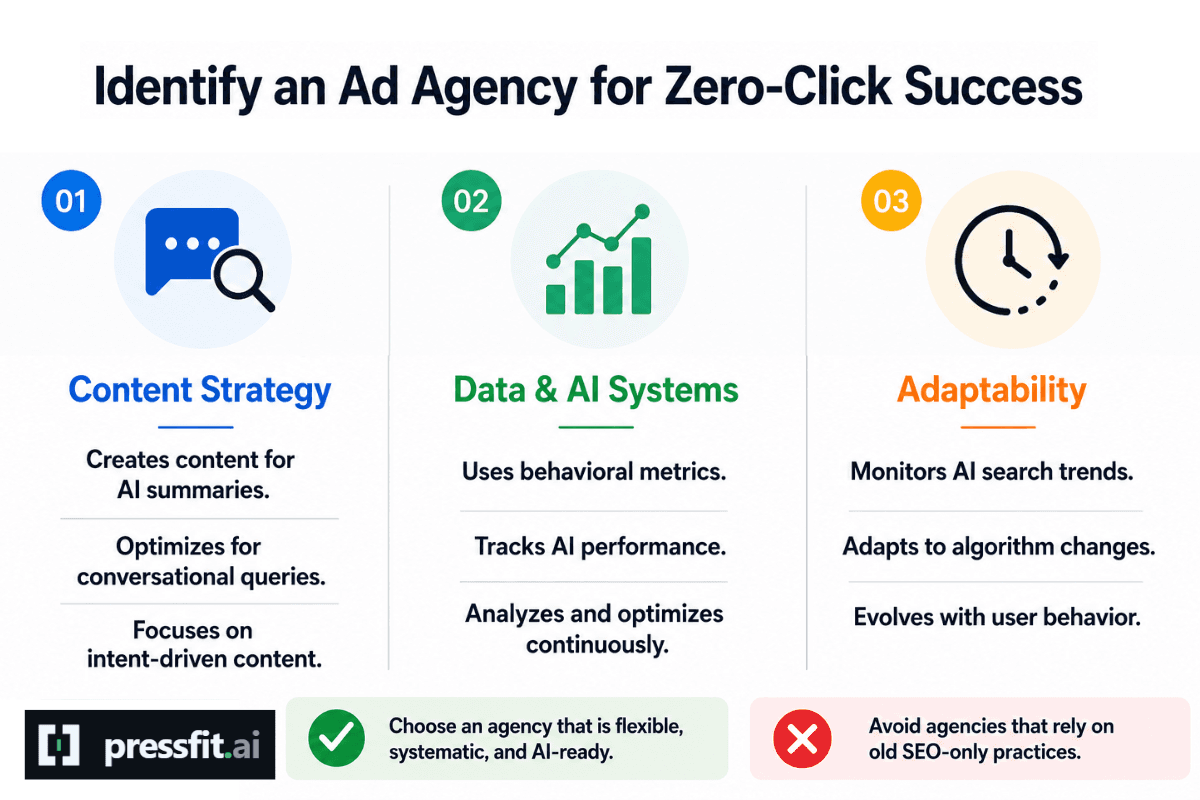
How can businesses identify an ad agency prepared for zero-click search?
You can tell by how an agency approaches AI visibility, conversational search, and adaptive content planning. Choosing well buys long-term influence rather than short-term traffic. Three signals.
- They produce content built for conversational questions, AI-generated summaries, and intent-driven search, not for a keyword export.
- They use behavioral metrics and AI performance tracking, and can put last quarter's numbers beside this quarter's on the same question set.
- They adjust quickly when AI search behavior changes, and can name what they changed and why.
An agency with all three tends to be flexible and systematic about AI visibility. An agency with none is still reporting SEO alone, and will keep doing that for as long as you accept it.
What AI search strategies should modern digital agencies use?
Modern agencies should work on intent matching, content structure, semantics, behavioral analysis, and conversational optimization. Content has to be built for AI search algorithms, not only for ranking, and structuring it around intent is what lets an AI identify relevance.
Behavioral analysis lets campaigns be optimized around how users interact with AI recommendations, and agencies also have to keep adjusting their messaging as AI search and buyer behavior change. It is the part most often skipped. Our breakdown of the signals that appear to drive AI search visibility is where we would start a plan.
How to run the conversation
Ask all eight in one sitting, write the answers down, and ask again next quarter. What matters is the movement between the two sets, not today's score; nobody needs to answer all eight yet.
Conclusion
Choosing what to ask your advertising company in the age of zero-click search means moving from traditional marketing metrics to AI-focused ones. AI search engines put their weight on understanding, summarizing, and conversational search rather than ranking alone. Companies that optimize for AI search visibility will beat the ones optimizing only for SEO.
How Pressfit helps businesses improve AI search visibility and zero-click performance
Our AI visibility work combines AI-driven analytics with behavioral data to evaluate how your content performs across AI-powered search. We run your buyer question set through ChatGPT, Claude, Gemini, Perplexity, and Google AI Overviews on our own citation-tracking platform, capture each citation as first-party data, and report your share against named competitors by engine and by question cluster. So you measure influence inside AI answers, not only rankings.
Our content audit reads the page-level signals the engines rely on, and our content gap analysis finds the questions competitors are cited for and you are not. Recommendations cover content structure, messaging, and intent alignment, and every one traces back to an answer we recorded. If you want a read on where you stand across the answer engines, talk to us.
FAQ
What is zero-click search in digital marketing?
A zero-click search is one where the user gets the answer inside the results themselves, from an AI Overview, a featured snippet, or an assistant like ChatGPT or Perplexity, and never clicks through to a website. The impression still happens. The session does not.
Why should businesses change the questions they ask ad agencies?
Because current performance measures do not capture visibility inside AI-powered search. An agency should be able to justify how it accounts for conversational search, AI recommendations, and zero-click visibility.
Can businesses gain visibility without increasing website traffic?
Yes. AI platforms can condense and reference your content inside the search interface itself. If the content is concise, organized, and matches what the reader needs, it can sway the decision without anyone clicking through.
How does Pressfit support businesses in AI-powered search environments?
We analyze AI visibility, behavioral engagement, and conversational search performance across AI-driven systems, then hand back changes to content structure, semantic clarity, and intent alignment. The aim is to help you judge whether an agency is ready for zero-click search.