A national campaign reports one number, and that number is an average that hides the regions paying for the regions that convert. Measure by region first, localize where the data says behavior actually differs, and leave the rest alone. Localizing everywhere is its own kind of waste.
One national number is an average that hides which regions fund which
Multi-location SEO usually starts in the wrong place. A brand with sixty stores or forty service areas runs one campaign and reports one conversion rate, one cost per acquisition, one organic traffic line. That line is an average, and an average is the one number guaranteed to describe none of your regions accurately.
Underneath a flat national number there is almost always a spread. Some regions convert well above the average, some sit well below it, and the ones below are funded by the ones above. Nothing in a rolled-up report tells you which is which, so the budget keeps moving as one block. That is the same failure pattern as optimizing the wrong marketing KPIs. The number is real. It is just answering a question nobody asked.
Local content and local ads let a national brand adjust its messaging and targeting to the habits of the audiences living in each place. Rather than running a single campaign everywhere, a brand can run location-based campaigns that are more relevant and more effective.
With online competition increasing, brands need an approach that handles scale and precision at once. Localized marketing gives the brand a setup where the campaign adjusts to the performance of each region and the behavior of its users. The useful first move, though, is not more localization. It is finding the variance, because you cannot decide where a local page or a geo-targeted ad is worth building until you know where behavior actually differs.
What Is Local Content, and Why Does It Matter to National Brand Development?
Local content is marketing content customized for the region it is aimed at, through culture, language, visual cues, and more. These all take into account intent from the user's perspective, which makes the content relevant to their expectations within their region. A national page with a city name dropped into the heading is not local content, because it gives a buyer in that city nothing they did not already have.
Local content matters to national brands because audiences in different geographic regions behave differently. Content that succeeds in one region can be ineffective in another, and a brand running one message everywhere never finds out which is which. With localized content, brands aim for effectiveness and interaction with their audience. Whether they get it is something to measure market by market, not something to assume, and that qualifier carries the rest of this post.
What Are Local Ads and How Do They Improve Geo-Targeting?
Local ads are advertisements selected by geographic data: location cues, search intent, and behavior. These types of ads help companies send relevant information to a certain audience within certain geographical locations, so campaigns speak to local needs instead of following one generalized approach.
The controls themselves are ordinary and documented. Google Ads supports targeting and excluding locations at country, area, city, postal code, and radius level, and adjusting bids by location, as its location targeting documentation sets out. With geo-targeted ads, a company can fine-tune its targeting by adjusting messaging to regional behavior.
- Reach users based on real-time location signals
- Align messaging with local search intent and demand
- Focus campaigns on high-intent regional audiences
- Reduce wasted spend on irrelevant geographic segments
The result is meant to be more accurate targeting, reaching the users more likely to respond, with better regional data to decide from. Take that last bullet carefully. Narrowing a region is intended to put less money in front of audiences who were never going to convert. That is what the control is designed for. It is not a measured outcome we can attach a percentage to, and neither can anyone quoting one at you, which is exactly why it is worth measuring in your own account rather than assuming.
How Can Local Content and Ads Benefit Marketing Strategy in Different Areas?
Local content and local ads are meant to improve marketing results by raising relevance and matching consumer behavior in a particular geographic region. When the message is aligned with the local setting, people are more likely to interact with it.
Localized approaches also help brands decide from performance data rather than instinct. Campaigns become adaptable instead of static, which improves brand communication over time. There is a feedback loop here, because every localized insight adds back into the overall marketing strategy. A region is a smaller and faster test than a national launch. A phrase that outperforms in three metros is a candidate for the national headline. An objection that shows up in one region is often the same objection everywhere, stated more plainly.
Why do national marketing campaigns fail when not localized?
National campaigns fail when they stay generic and take no account of the behavior and culture of each locality. They usually still build awareness. They lose the step after it, and often fail to turn prospects into customers.
- Lower message relevance: A general message does not fit the regional culture, and it is written for an average buyer who does not exist in any particular market.
- Inefficient budget allocation: Targeting too broadly sends money to areas where performance is poor, or where the offer cannot be delivered well.
- Inconsistent performance across markets: Identical tactics meet different competition and different demand, so outcomes differ a great deal and the blended number hides the scatter.
The inability to localize leaves no capacity to adapt in response to performance indicators. The brand cannot see which areas are performing and which need adjusting, so the process becomes assumption-based instead of data-based. That is a measurement failure before it is a content failure.
Measure the regional variance before you spend against it
Regional measurement is the cheapest part of multi-location SEO and the part most often skipped. You already collect the data; it is summed before anyone looks at it. Four steps get you a picture you can act on.
- Pick the unit the business actually runs on: a store trade area, a metro, a service territory, a state. If a manager owns a territory, that territory is the unit.
- Split what you already have by that unit. GA4 exposes country, region, and city alongside every event, as its Data API schema documents. Sessions, conversion rate, form completions, and revenue can all be cut this way today.
- Compare conversion, not traffic. Traffic differences mostly reflect population. Conversion differences reflect behavior, and behavior is the thing localization can change.
- Check the search surface region by region. Rankings and AI answers are not the same everywhere, which we cover in our explainer on why AI search rankings vary by location. Sample from the places you operate, not from head office.
Then set a bar before you look. Decide in advance how large a gap counts as different, and how many conversions a region needs before its rate means anything. A region with eleven conversions in a quarter is mostly noise.
Not every regional gap has the same cause, and the response depends on the cause. Three patterns cover most of it.
Demand differs
People in one region want a different thing, or want the same thing in different words. The tell is query mix: the terms bringing people in are not the same set across regions.
Conversion differs
Same demand, same traffic quality, different outcome. Something between arrival and action is regional: delivery windows, hours, staffing, stock, pricing, or a competitor two blocks closer. The tell is a conversion gap that survives when you hold channel and query mix steady.
Competition differs
The result page itself is different. A national brand sitting at position two nationally can sit below three local operators in a single metro. The tell is a visibility gap in one region while the pages and the offer are identical everywhere.
If a region shows none of the three, it does not have a localization problem. Leave it on the national program.
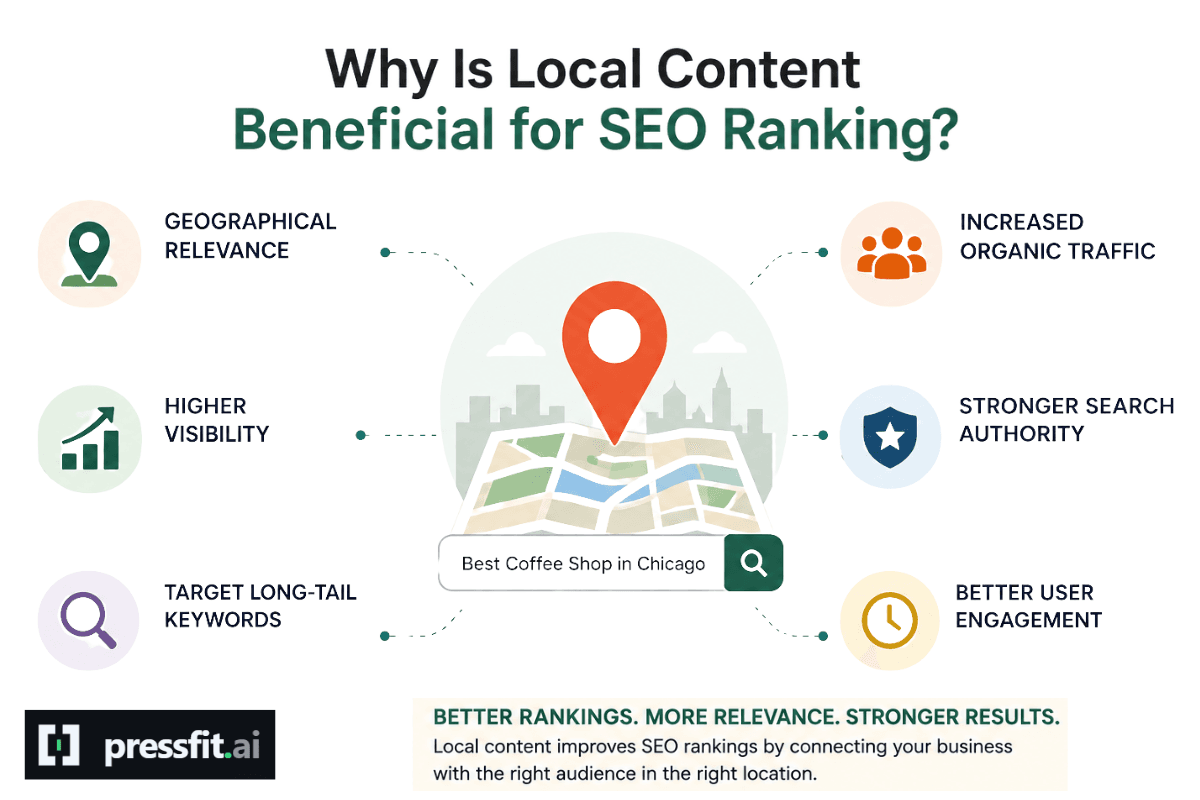
Why Is Local Content Beneficial for SEO Ranking?
The benefit of localization within SEO comes from the geographical relevance of the content, which means the content is relevant to searches made in certain locations. The mechanism behind multi-location SEO is that simple: a search made in a place tends to return results relevant to that place, so a page genuinely about that place has something to be relevant with. Search engines give geographically relevant content a chance at ranking in local searches.
Through the creation of localized websites and content, companies get a chance to increase their visibility within different markets. That visibility comes from organic traffic through which companies can engage users. They are also able to capture long-tail keywords within different locations, the longer and more specific phrasings each region uses, which the national page never contained.
Eventually, local content develops increased search authority, allowing companies to achieve consistent rankings. Such an approach also increases dwell time, reducing the chances that visitors leave the website immediately after arriving. In this way, a company improves its ranking position without sacrificing relevance to geographically separated audiences.
Those three are the expected effects of giving a reader information they could not get elsewhere, and they are reasonable things to aim at. We have not found published research that measures them, and we are not going to quote a number nobody can source. Treat them as a hypothesis to instrument rather than a result to bank. Record the market's baseline before the page ships, then read engaged sessions and conversion for that market afterwards.
One prediction we will make. If the page is a template with a city name in it, expect none of those effects, because the page added no information for anybody to stay for.
Localized landing pages, built only where the difference is real
Localized landing pages are the workhorse of multi-location SEO, and also where the most money gets wasted. The waste has a signature: a template with the city name swapped into the heading, the meta description, and one sentence at the bottom, published two hundred times.
A localized landing page earns its place when it carries facts that are true only there:
- The address, hours, and service area for that location, with the people who work there.
- Inventory, pricing, or service availability that genuinely varies by region.
- Proof from that region: reviews, work completed, named customers, photographs of the actual site.
Mark those pages up so the facts are machine-readable. Google's LocalBusiness structured data guidance covers the properties that describe an individual location, including address, opening hours, and the department pattern for one address holding several units. If your locations span countries or languages rather than metros, Google separately documents how to signal localized versions of a page. That guidance covers country and language variants, not city pages within one market, so do not stretch it further than it goes.
Localized content strategies work the same way at the portfolio level as on a single page. Build where the facts differ. Where the facts are identical, one strong national page will outperform forty thin regional copies of it.
How Do Local Ads Improve Conversion Efficiency?
Local advertising is meant to improve conversion efficiency by delivering messages matched to geography and intent. Users who see an ad that speaks to a local need are more willing to act. Three effects get claimed. Each is worth pursuing, and each is worth measuring rather than assuming.
- More relevant communication. The localized ads ensure the users' needs are fulfilled because their preferences are taken into account. That is message match, and it is the cheapest of the three to test.
- Reduced wasted spend. Excluding the geographies you cannot serve is meant to move budget away from low-intent audiences. The control exists and works. The size of the effect belongs to your account, not to a case study.
- Stronger user intent alignment. Ads answering a need that is specific to a place should bring in better-qualified leads than a generic one.
That is how campaigns are supposed to get more efficient without total spend going up. A figure from someone else's campaign is not evidence about your business, so we will not hand you one. What makes these checkable is instrumentation. If your conversion events map back to CRM stages, you can see whether the regional cut of your spend produced better pipeline or only cheaper form fills, which is the difference our guide to closed-loop marketing attribution exists to make visible.
Geo-targeted advertising is often sold as a reach tool: show the ad to people near a store. That is the smallest thing it does. Its real value is turning region into a budget decision, so cut spend where the offer cannot be fulfilled before you add anywhere else.
How does Pressfit contribute to optimizing local content and advertising systems?
Pressfit optimizes local content and local advertising as one layer where artificial intelligence comes together with behavioral knowledge. Our growth engine runs messaging, AI search visibility, paid acquisition, and content optimization together instead of through four vendors, with every channel reporting its response signals into a single behavioral intelligence model. Region is one of the cuts that model reads, so a difference found in paid can redirect the content roadmap, and a difference found in organic can redirect spend. Rather than using set systems, that lets you constantly test and tweak your messaging.
The measurement underneath it comes from our analytics implementation: GA4 and Tag Manager configured for long, considered buying journeys rather than retrofitted ecommerce defaults, server-side tracking, behavioral telemetry beyond pageviews, our LLM citation tracking so AI answers become a comparable channel, and conversion events mapped to CRM stages so a regional gap can be traced to revenue instead of stopping at form fills. Consent Mode v2 is the default. That is how performance statistics and user behavior get read region by region. By doing so, a brand can work past assumptions to create marketing strategies that learn and adapt with time.
What we will not do is tell you that localization lifts rankings or cuts waste by some published percentage. We have no source for that, and neither does anyone quoting it at you. What is checkable is structural: results differ by region, most reporting hides that difference, and you can only act on what you can see. If you want the regional picture your current reporting is averaging away, talk to us.
Localizing everywhere is its own kind of waste
Advice on this topic almost always ends at localize more. It ignores what localization costs after launch.
Every localized page is a page somebody has to keep true. Hours change, staff leave, a location closes, and a hundred near-identical pages quietly start lying to buyers. Every extra ad group splits volume until each region holds too little data to tell a real change from noise.
So the rule is narrower than do more of it. Localize where the measurement says behavior differs and the difference is worth the maintenance it creates. Everywhere else, stay national. Restraint here is not laziness. It is what keeps the pages you did localize accurate.
What Is the Future of Local Content and Local Ads in Marketing?
The future of localized marketing is about automation, personalization, and optimization. It is imperative for brands to create personalized experiences for their audiences in line with what consumers now expect from them, including the page and the ad reflecting where they are.
As AI tooling improves, campaigns can self-optimize against their own performance data, and producing a variant per region keeps getting cheaper. That sounds like an argument for localizing everything. It is the opposite. When variants are cheap to produce, the scarce resources become accuracy, maintenance, and the ability to tell a real regional difference from noise. Automated production without automated measurement just manufactures thin pages faster. Brands can scale localization without scaling complexity only if they automate the reading of regional performance first, so that the cheap variants get pointed at the places that earned them. Either way, localization is becoming an integral part of any effective digital advertising campaign.
Conclusion
A brand that wants better engagement and conversion while scaling across several markets needs both local content and local ads, and it needs them narrowly. Through marketing systems that correspond to the behavior and intent of people in certain areas, brands create more effective campaigns. Build a page where the facts in that market genuinely differ. Fund the region the numbers say deserves funding. Everywhere else the national program is fine, and it is far cheaper to keep true. In a competitive environment, the brands that get steady results across many markets are not the ones that localized the most. They are the ones that knew which places deserved it.
FAQ
What is multi-location SEO?
Multi-location SEO is the work of making a single brand findable and persuasive in each of the places it operates, rather than as one national entity. In practice it covers regional measurement, location pages carrying facts that are true only in that market, structured data describing each location, and search visibility checked region by region instead of from head office.
What Is Local Content in Marketing?
Local content in marketing is content customized for a particular geographic target audience through regional messaging, language, and user intent. The benefit is that brands can raise their relevancy and engagement through marketing campaigns. A national page with a city name swapped into the heading does not qualify, because it gives a buyer in that city nothing they did not already have.
Why Are Local Ads Important for National Brands?
Local advertisements help national companies by letting them use geographically oriented messages. That is meant to create more engagement and improve conversions, and to target ad spend at interested people in particular geographical locations. Practically, it turns region from a rounding error into a budget decision: hold each market to its own baseline, and stop paying for places where the offer cannot be delivered.
How Do Local Ads Improve ROI in Digital Marketing Campaigns?
Local advertising is meant to enhance ROI by directing messages to people who live in particular places. That is designed to prevent wastage of money and improve the efficiency of conversions, so campaigns yield results for the business. We will not quote a percentage for it, because we have no source we can stand behind. Whether it improved your return is something to measure in your own account, with conversion events mapped back to CRM stages so you can see pipeline rather than form fills.
How Can Businesses Combine Local SEO and Ads for Better Results?
Companies can integrate their local SEO and advertising efforts by using local keywords, building local landing pages, and launching local campaigns. That improves visibility, enhances interaction, and keeps performance consistent between organic search results and pay-per-click advertising. Run both off one regional read: organic tells you what a region asks for, and paid lets you act on it immediately.
Should every location get its own landing page?
Only where the facts differ. A localized landing page earns its place when it carries an address, hours, staff, inventory, pricing, or proof that is specific to that market. If the only difference between two pages is the city name in the heading, one strong national page will do more and cost less to keep accurate.
How do I tell whether a region is genuinely different or just noisy?
Set the bar before you look. Decide in advance how large a gap counts as different and how many conversions a region needs before its rate is meaningful. Compare conversion rate rather than traffic, since traffic differences mostly reflect population, and hold channel and query mix steady so you are comparing like with like.
What are geo-targeted ads useful for beyond reaching nearby customers?
They make region a budget decision. Once you have measured how each region performs, location targeting lets you fund the regions that carry the average, hold each region to its own baseline instead of the blended national number, and stop spending in places where the offer cannot be fulfilled well.