Every agency now says it understands AI, so that claim cannot help you choose one. What can help is knowing the five factors that decide whether an agency can do this work, and having seven tests that prove them: for each one, the evidence to ask for, what a real answer sounds like, and the answer that should end the conversation. We are an agency, so we wrote the tests to be usable against us too.
An Agency Wrote This Guide About Choosing an Agency
We are a digital agency, and this is a guide to choosing a digital agency. That is a conflict of interest, so the only honest way to write it is to make it usable against us. Every test below has a stated pass condition and a stated fail condition. Run them on Pressfit, and if we fail, do not hire us.
Choosing a digital agency in the new world of AI means evaluating how effectively the agency operates within AI-driven environments, rather than relying only on traditional marketing capabilities. Businesses must shift from selecting agencies on surface-level metrics to selecting them on their ability to influence AI searches, interpret user intent, and optimize AI search visibility.
The future of digital marketing is no longer entirely dependent on ranking, traffic, and impressions. AI searches can already answer questions, summarize, and recommend solutions without anyone clicking a website. Companies therefore need agencies that know what happens to their content when it passes through AI technology. A wrong choice of agency results in poor performance.
Most agency-selection advice hands you adjectives instead. Experienced. Data-driven. AI-first. An adjective is something an agency tells you; a test is something you make it show. Adjectives cannot disqualify anybody, which is why every agency is comfortable using them.
What Does a Digital Agency Do in the AI Era and How Does It Work?
A digital agency in the AI era focuses on improving visibility, engagement, and conversions by aligning strategy with AI technology, behavioral data, and intent-based optimization. The role of the agency has shifted from executing campaigns to continuously optimizing how content performs across AI searches and decision environments.
Agencies are no longer simply service providers. The agency becomes an adaptive system that evaluates performance, clarifies messaging, and redesigns content based on how the AI system interprets meaning. Agencies therefore have to make sure their content is clear, organized, and meaningful enough for that meaning to be extracted.
Where SEO-driven agencies care about rankings and traffic, AI-driven agencies focus on understanding, visibility, and influence. The disparity shows up in how the business grows.
The category has picked up new names to match: answer engine optimization agency, AI SEO agency, answer engine optimization services, AI search optimization services. The labels are cheap; what matters is whether the work behind them is real.
Why Has the Selection of the Right Digital Agency Become Important?
Selecting the right digital agency depends on how your company gets presented through AI-powered platforms, and on how that presentation shapes user decisions. Visibility today does not equal selection, summarization, and trust by AI.
That leads to a paradox: agencies that cannot work with AI can drive traffic and still have no impact for their clients. Those companies cannot engage customers, get conversions, or grow steadily, despite stable rankings.
It creates a second discrepancy, between traffic and influence. Traffic suggests visibility on conventional search. Influence is presence in AI-created responses. Businesses that do not see the difference risk hiring agencies that optimize for the wrong parameters.
How Is AI Changing the Way Digital Marketing Agencies Operate?
AI is reshaping digital agencies by changing workflows from manual to automated, data-driven processes. Those processes adapt continuously depending on how they perform.

Marketing campaigns no longer stay static. Strategies have to be adjusted continuously, through how users interact with the content and through how AI technology interprets searches.
AI also turns digital agencies into organizations that optimize processes rather than execute tasks. They work constantly to adapt strategy and hold visibility, while watching how the campaign performs.
The good version of this makes an agency an optimizer. The bad version is the same static plan with automation bolted onto the reporting, which is why the claim has to be tested rather than believed.
What Factors Should You Evaluate When Choosing a Digital Agency?
Selecting a digital agency needs several factors weighed together, to gauge how effective the agency is in AI-enabled surroundings. Businesses need to judge both capability and adaptability, instead of focusing only on past successes.

- AI Capability and Technology Usage: the agency should apply AI to analyzing data and automating processes, so operations scale efficiently across all campaigns.
- Understanding of AI Search Visibility: the agency should understand how AI search visibility works, and how content is selected, summarized, and presented within AI searches. That is what puts content where decisions are made.
- Data-Driven Strategy: the agency should use data to guide decision-making and strategy development, eliminating guesswork.
- Content Structure and Clarity Expertise: the agency should create structured, clear, intent-aligned content that AI systems can interpret easily. That increases the probability of inclusion in AI-generated responses.
- Adaptability and Continuous Optimization: the agency should constantly evolve its approach to adapt to changes in AI technology and user behavior.
All of these factors work together. If one factor is missing, performance may decline. Businesses must evaluate agencies holistically rather than selectively.
The five factors are what to evaluate. The seven tests below are how. Each test makes one of the factors visible, so an agency cannot pass by asserting it.
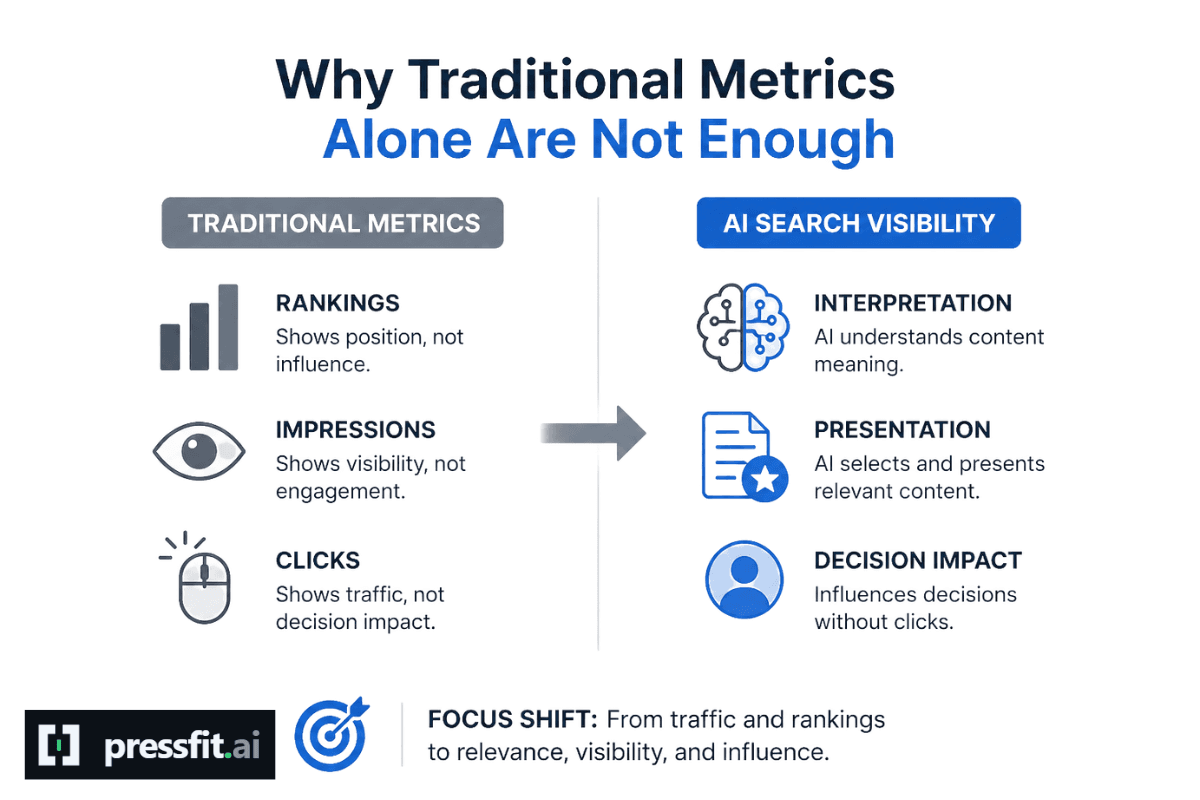
Why Traditional Metrics Alone Are Not Enough
Rankings, impressions, and clicks are no longer enough to determine performance in AI environments. AI searches emphasize interpretation and presentation over placement. Content can therefore affect a decision without producing any click-through.
Companies can fail to recognize the worth of content that scores high in AI-produced answers yet receives no traffic. High-ranking content will not show up in an AI search if it is unclear and misaligned with intent. Low-ranking content will score high on AI search visibility if it is relevant.
The longer version of that argument is in our piece on brand visibility versus website traffic in the zero-click era. For choosing an agency, one consequence is enough: if every number in the pitch is a placement number, the agency is still reporting on the old surface.
Seven Tests That Make Those Five Factors Visible
Each test names the evidence to ask for, what a real answer sounds like, and the answer that should end the conversation.
Test 1: Make the agency show your baseline before it shows you a pitch
Ask for a read on where you stand today, before you hear the pitch. Any agency worth hiring can assemble a dated baseline from public data without a contract, and its shape tells you what they are equipped to measure.
- Ask for: the prompts your buyers would actually type, which answer engines were checked, whether you were cited in each, and the date.
- A real answer sounds like: a named prompt list, named engines, a mention count you can recount by hand, and a plain statement of what they could not measure and why.
- End the conversation if: the baseline is a traffic chart, a domain-authority score, or one undated screenshot of a single ChatGPT session.
Two parts of this are hard to fake. Answer-engine crawlers identify themselves in your server logs, and OpenAI publishes the names its crawlers use, so whether AI systems reach your pages is answered in a log file. Site performance is checkable too, since Core Web Vitals defines specific numbers to clear.
Test 2: Ask who will own the accounts, the data, and the tracking
Ownership decides how much leverage you have on the last day of the relationship, which is the day it matters. It is also the easiest thing to settle in writing before you sign.
- Ask for: a list of every account that will be created or touched, and the owner of record on each: analytics, search console, ad accounts, tag manager, the site repository, the citation tracker.
- A real answer sounds like: your company as owner on all of them, agency users added with access you can revoke, and an offboarding step described without being asked about.
- End the conversation if: the tracking lives in an account you cannot log into, or the reporting comes only as a slide deck built from data you cannot reach.
An agency that keeps the measurement layer in its own name has made switching expensive on purpose, and you should price that in.
Test 3: Ask how content gets made and who is accountable when it is wrong
Nearly every agency now drafts with a language model, including us, so asking whether they use AI is a dead question. The live question is what sits between the model and your published page.
- Ask for: the production path for one page, from research input to published URL, naming who reviews facts, who checks claims against your product, and who signs off.
- A real answer sounds like: a named human accountable for accuracy, a stated source standard, and a volume a person could plausibly review.
- End the conversation if: the pitch leads with how many pages per month they can ship, and nobody can name the reviewer.
Volume without review is not only an editorial risk. Google's search spam policies describe scaled content abuse as a policy violation in its own right, so the downside of a high-volume program lands on your domain, not the agency's.
Test 4: Ask which number they would expect to be fired over
Agencies report on what makes them look good unless you fix the scoreboard first. Make them name a single number, before the proposal, that they would accept as the verdict.
- Ask for: one primary metric, its current value, how it is measured, and how far into the funnel it sits.
- A real answer sounds like: a number tied to pipeline or revenue, with an admission of what the agency does not control.
- End the conversation if: the answer is impressions, sessions, keyword rankings, or engagement, and it stays there after you push.
The trap is that the wrong metric can be reported honestly and still be useless, which we cover in why marketing agencies are optimizing the wrong KPIs. A metric you cannot connect to money is a metric nobody can be fired over.
Test 5: Ask what their AI actually does, and who built it
"Proprietary AI" covers everything from a purpose-built measurement system to a saved prompt in a shared document. The difference is not visible in a deck, so make them open it.
- Ask for: a live walkthrough of the thing itself, with your own domain or category as the input.
- A real answer sounds like: a system they can drive in front of you, that reads data you can inspect, and that they can explain a recommendation from.
- End the conversation if: the demo is a recorded video, a screenshot, or a public chatbot with the agency's logo on the browser tab.
Who the tool was built for matters more than who built it, the subject of AI built by marketers versus AI built for marketers. Does the system read a signal specific to your buyers, or the same public model your competitor's agency reads?
Test 6: Ask what AI has done to their price
If a shop has genuinely automated its research and production, its cost to serve you has moved. Ask what happened to the price when that cost moved, and listen for specifics.
- Ask for: what is priced by output, what is priced by outcome, what the automation replaced, and where the saving went.
- A real answer sounds like: a straight account of the trade, including the honest version, that automation went into more depth or wider coverage rather than a lower invoice.
- End the conversation if: they are billing the same hours for work a machine now does, and the question makes them uncomfortable.
We made this argument in full in is your marketing agency using AI but not passing the savings to you. You are checking whether the pricing story and the automation story survive being told by the same person.
Test 7: Ask what they would tell you not to buy
This is the cheapest test on the list and the most revealing. An agency that wants a long relationship will have something it thinks you should not buy yet.
- Ask for: the part of their own service list they would take off your scope, and why.
- A real answer sounds like: a specific exclusion with a condition attached, such as leaving AI search optimization services alone until the pages an engine would cite actually exist.
- End the conversation if: everything they sell is recommended, in the order it appears on their pricing page.
An agency that cannot name a boundary has not scoped you. It has quoted you.
Three Answers That Should End the Conversation on the Spot
Some answers are not weak, they are disqualifying, and they are worth knowing before the call so you recognize them in the moment.
- A guarantee of placement in AI answers. Google's documentation on AI features in Search describes those experiences as drawing on the same index and the same technical requirements as ordinary Search, so there is no submission path and no inventory to buy. A guarantee is either a misunderstanding of the mechanics or a claim made knowingly.
- A method they will not describe. Structured data is a public vocabulary published at schema.org and visible in any page source, so "proprietary technique" applied to it is a way of avoiding the question.
- A number you cannot reproduce. If a reported figure cannot be recounted from data you have access to, it is not a measurement you own. It is a claim you are being asked to accept.
How Businesses Can Identify the Right Digital Agency
A business can identify the right digital marketing agency through an evaluation process focused on strategy, implementation, and adaptability. Identification should be based on capabilities rather than branding and pricing.
The first step is looking at how the agency structures content, and whether that structure aligns with AI searches and user intent. Second, check how data systems are being used to measure performance and adjust strategy where necessary.
Last, consider the agency's adaptability in light of changes in the AI landscape. Successful agencies show consistency, clarity, and tangible results. Poor ones depend on guesswork, obsolete processes, and rigid strategies.
How Pressfit Improves Agency Selection and Performance in the AI Era
Pressfit improves agency selection and performance by combining AI technology with behavioral data to analyze how content performs across AI-driven environments. Businesses can then evaluate not only what agencies do, but how well their strategies work in real conditions.
Our platform monitors performance indicators such as engagement, interaction, and AI search presence. It recommends improvements to structure and messaging for intent alignment, which creates a feedback loop for continuous optimization based on real performance rather than assumptions.
That approach moves firms away from conventional marketing strategies and towards performance-based systems. It makes sure the agency you choose is consistent with AI search and produces reliable results.
Our own answer to Test 1 is our growth engine, which runs ICP messaging, AI search visibility across AEO and GEO, paid acquisition, and content optimization as one engagement with a single behavioral-intelligence layer underneath. The scope is deliberately bounded: our growth engine stops before the full pipeline build.
On ownership, the accounts and the data stay in your name. On pricing, we do not publish a price grid; engagements are scoped on a discovery call, and you get the engagement shape and an investment range in writing before you commit. We also run a white-label program, so some of the agencies reading this are partners reselling our stack under their own brand, which we would rather say plainly than have you discover later.
Here is how to disqualify us, using the same tests. If you need outbound sequencing and sales enablement rebuilt, our growth engine is the wrong tier. If you require published, fixed prices before a conversation, we will fail that. If you want a guarantee that ChatGPT will cite you by a given date, we will not sell you one, and any answer engine optimization agency that will is worth a second look for a different reason. If none of those rule us out, tell us what you are trying to measure and we will start with the baseline.
Conclusion
Choosing a digital marketing agency in this modern era of artificial intelligence involves a departure from conventional practices and the adoption of a systematic, evidence-based method. Businesses need to focus on AI-driven visibility, intent matching, and flexibility rather than ranking and traffic alone.
Agencies that understand how AI works and how consumers behave will outperform the ones applying obsolete techniques. Businesses that pick the right agency will attain higher visibility, better engagement, and sustained conversions.
The buyer who insists on evidence gets first pick of them. Ask for the working. Hire whoever brings it.
FAQ
What is the most important factor when choosing a digital agency today?
The key consideration now is the agency's capacity to optimize for AI search visibility through structured content and a data-based approach. AI searches focus on clarity, intention, and context rather than ranking alone. Agencies that know how to make AI work for them are the ones that will succeed on visibility and conversions. Treat it as a capability to verify rather than a claim to accept, because every agency now asserts it.
How do AI searches affect digital marketing agencies?
AI-based searches change the goal from ranking and gaining traffic to interpretation and intent alignment. Digital marketing agencies have to create structured, coherent, relevant content that can be used to build AI-powered answers. The effectiveness of a strategy now relies on how well AI understands the content, rather than on where it ranks.
Can a digital agency improve visibility without improving rankings?
Yes. AI search visibility relies on how content is interpreted and presented. If content is structured and targeted at the user's intention, it can appear in AI responses even when it does not rank high on search engines. The reverse also happens: a high-ranking page that is vague or aimed at the wrong intent can be left out entirely.
How does Pressfit help in choosing the right agency?
Pressfit applies AI technology and behavioral data analysis to assess how effective content is on AI-powered platforms. We evaluate engagement, interaction, and visibility metrics to produce meaningful insights, so companies can choose agencies that are well suited to AI-powered searches. We are also one of the agencies you would be choosing between, so treat this as disclosure rather than neutral advice.
How do I choose a digital agency in the AI era?
Replace adjectives with tests. Ask for a dated baseline of where you are cited across answer engines before you hear a pitch, settle who owns the accounts and the data, learn who reviews content for accuracy, make them name the one metric they would expect to be fired over, watch their AI run live on your own domain, ask what automation did to their price, and ask what part of their service list they would tell you not to buy. Any criterion that cannot disqualify an agency is not a criterion.
Can an agency guarantee my brand appears in ChatGPT or Google AI Overviews?
No. Google's documentation on AI features in Search describes those experiences as drawing on the same index and the same technical requirements as ordinary Search, so there is no submission path and no placement to buy. An agency offering a guarantee is either misunderstanding the mechanics or making a claim it knows it cannot support. What a credible agency can commit to is measurement: which prompts, which engines, and whether your citation rate moved.
What should I ask an answer engine optimization agency for before signing?
Ask for the prompt list they would track and why those prompts represent your buyers, the engines they check, your current citation rate with the date it was measured, and what they could not measure. Ask to see whether AI crawlers are reaching your pages, which is answerable from your server logs because those crawlers identify themselves. If the only evidence offered is traffic or rankings, they are measuring the old surface.
Is a specialist AI search agency better than a full-service digital agency?
It depends on what is actually broken. A specialist is the better fit when your pages are sound and the gap is visibility in answer engines. A broader agency is the better fit when messaging, content, and paid are pulling in different directions, because the fix is coordination rather than one channel. The way to settle it is Test 7: ask each of them what they would take off your scope, and hire the one whose exclusion matches what you already suspect.