AI search visibility is whether your content survives into the answer a buyer reads, which is a different question from where your page sits in a list of links. Almost every team measures the second and skips the first. This is what the two measurements are, why they disagree, how to take both on your own site, and what to do with the gap between them.
What Is AI Search Visibility and How Does It Work?
AI search visibility is whether your content shows up inside AI-generated responses, summaries, and recommendations, rather than where it sits in a list of search results. AI search does not revolve around placement. It revolves around relevance and how well your content matches what the user intended.
The future of search will not depend on ranking pages alone. Content can shape a decision without the user clicking anything. Companies will have to change how they measure success, optimizing content for how AI reads it rather than for ranking alone.
AI search visibility means the visibility of your content in AI-generated answers, highlighted snippets, and contextual recommendations. Conventional SEO earns visibility through rankings. An AI-driven system instead judges your content on how well it meets the user's intent and fits the context.
Your content can therefore show up in searches without ranking in the top results. The AI judges the content on meaning, clarity, and structure. That lets it surface in answers that address the user's question directly.
The full definitions, what answer engine optimization and generative engine optimization mean and how they sit against ordinary SEO, are written out in our guide to AEO, GEO, and SEO. This post takes them as read and goes on to the measurement.
Rank and Citation Are Two Separate Measurements
Rank answers one question: where does this URL sit in a list of links for this query. Citation answers a different question: when an answer engine writes a paragraph about this topic, does it draw on this page, and does it name you in the sentence a buyer actually reads.
Those two questions come back with different answers far more often than most teams expect. A page can sit outside the top ten and still be the source an answer quotes, because it stated the thing plainly while the pages above it buried the same fact in a table. A page at position one can be absent from the answer about its own topic, because the passage the engine needed was behind a form or written as a sales pitch rather than a claim.
The reason this goes unnoticed is that nothing reports it to you. Rank has a dashboard, several of them. Citation has none, unless you build one. Google's guidance for its AI features says there is no special markup that buys a place in an AI Overview, so eligibility runs through ordinary Search (Google Search Central). ChatGPT, Claude, and Perplexity report nothing back to publishers at all.
Why Can Content Be Visible Without Ranking?
Visibility in AI search is based on interpretation, not placement. The engine analyses content for useful information and then delivers it to users as an answer or a recommendation. That shifts things away from the traditional model, where ranking was the only route to visibility.
Content that is well organized and relevant to what users are looking for is more likely to be picked up. Even content that ranks poorly can still shape a user's choice. This splits traffic and influence into two different things, because content can work well without winning on ranking factors.
Ranking is a placement decision. Citation is an interpretation decision. An engine assembling an answer hunts for a passage it can lift and stand behind, so it favours content whose meaning is plain and whose claim matches what was asked. None of that requires the page to have won the link race first.
The practical consequence is that traffic and influence come apart. A page that sends almost no visitors can still put your name in front of a buyer at the moment they decide who to shortlist. Judged on sessions it is a failure. Judged on influence it may be one of your strongest pages, and nobody would know.
How Is Zero-Click Search Changing Visibility?
Zero-click search is when users get their answer from the search results page or an AI interface without visiting any website. It reduces ordinary browsing while still letting that information shape what people decide.

- Users get answers without clicking links
- AI systems summarize content into responses
- Decision-making happens within search interfaces
- Traffic becomes a secondary outcome
That change calls for a different way of evaluating success. Clicks used to be the only thing that mattered. Now companies have to make sure their material is part of what the AI generates.
There is a measured version of this. Pew Research Center found that when an AI summary appeared on a Google results page, users went on to click a traditional result on 8% of visits, against 15% of visits where no summary was shown (Pew Research Center). If the click is roughly halving while the reading is not, then judging content by the click alone is measuring a shrinking surface. We made that argument at length in our post on zero-click search and brand visibility.
What Signals Influence AI Search Visibility?
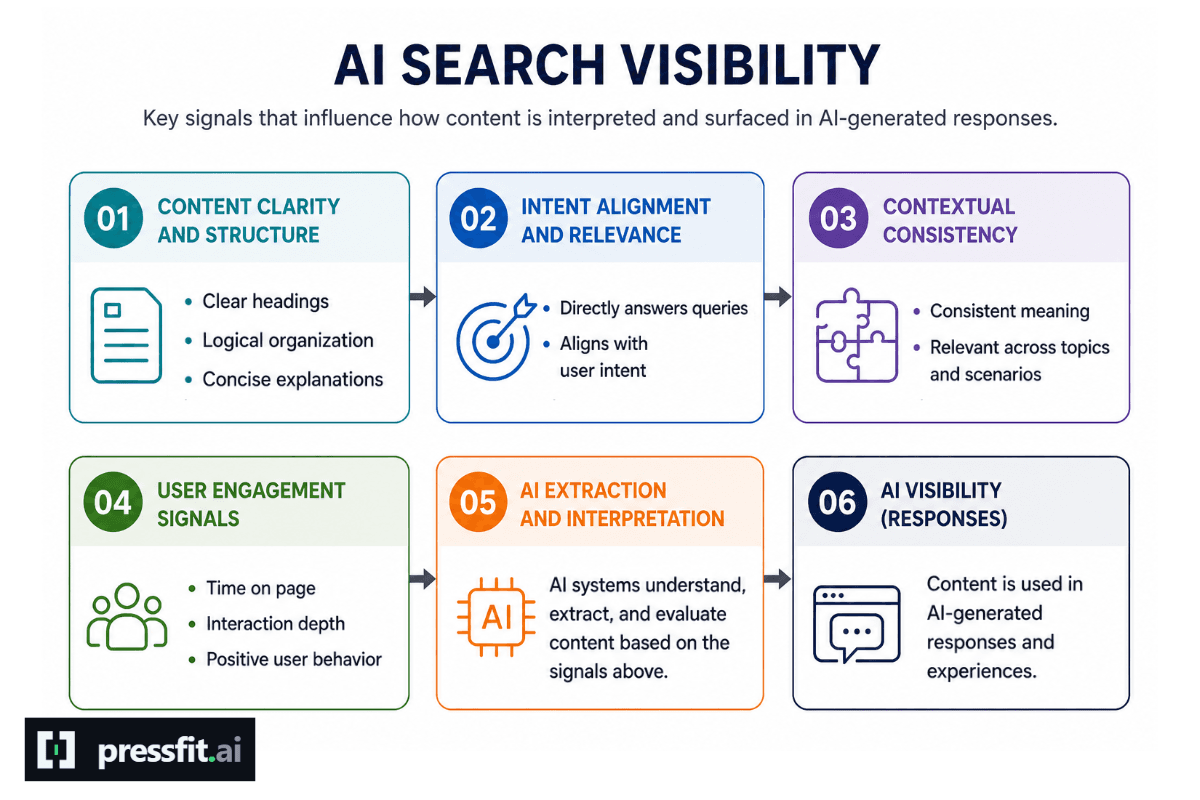
AI search visibility depends on how clearly your content expresses its meaning, its purpose, and how easily it can be interpreted. These signals decide whether the content can be extracted and featured in the answer an AI system generates.
- Content clarity and structure. How the content is organized matters for whether the AI can understand it. Structured content is easier to extract, and it is what the AI picks up to use in its output.
- Intent alignment and relevance. AI favours content that matches what the user intended when it builds a response. Content that matches user intent is more likely to appear in the output.
- Contextual consistency. Content that keeps a consistent meaning across related topics helps AI systems understand relevance across multiple queries and scenarios.
- User engagement signals. Metrics such as time on page, interaction depth, and user behavior are taken as indicators of content quality, and strong engagement is widely believed to raise the chance of being surfaced. No engine publishes this, so treat it as the field's working assumption.
All of these signals combine to influence whether content is included in the AI-powered search experience or stays merely visible. When the elements line up, it is much easier to understand what the author intends and to apply the content in other contexts, which is what AI systems reward.
We went through which signals hold up against published evidence in our review of the eleven AI search ranking signals.
Why Traditional SEO Alone Is Not Enough
Traditional SEO rested on keywords, backlinks, and rankings, and that is no longer enough on its own. AI-driven search rewards content that can be understood, repurposed, and adapted to many situations, rather than content that simply ranks.
Content that ranks high but is unclear, or misaligned in meaning, may never appear in the answers AI systems generate. There is a real difference between ranking and visibility. Companies need to move from keyword-based work to meaning-based content.
Keywords, links, and rank are still doing real work. They are how a page becomes reachable, and an engine cannot use what it never finds. Ranking gets a page into consideration; being quoted depends on whether it says something an engine can lift and repeat without hedging. None of the old work is thrown away. It gets extended, from optimizing for placement to writing for interpretation.
How to Measure AI Search Visibility on Your Own Site
You do not need a platform to take a first reading of your AI search visibility. You need a question set, a routine, and somewhere to write the answers down.
Start with questions, not keywords
A keyword list is the wrong input here. Buyers do not type saas conversion rate optimization into ChatGPT; they type a sentence with a constraint in it. Take the thirty to fifty questions your sales team actually gets asked, in the words the prospect used, and keep them in four groups:
- Category questions, where you want to be named at all: what tools do X, who does Y for companies our size.
- Comparison questions, where you want to be named accurately: what should a buyer look for, which vendors are credible.
- Named questions, where the engine already knows you exist: what does this company do, is it any good, what does it cost.
- Problem questions, where nobody names a vendor yet: why is this happening, how do we fix it.
The named group is the one teams skip, and the one that hurts most when it goes wrong.
Ask, then ask again, and write down what came back
Run the question set through each engine you care about, in a clean session with history and personalization off. Then run it a second time on a different day. A single answer is a sample of one. Answer engines are not deterministic, and a brand that appears once in three attempts is a different result from one that appears three times.
Record three things per question, not one:
- Were you named in the text of the answer.
- Were you linked as a source, which is not the same thing and often happens without the naming.
- Who was named instead, by name, every time.
It tells you which competitor the engine treats as the default answer in your category, which is a positioning fact rather than an SEO one.
Check who is actually fetching your pages
Your server logs hold the other half of the measurement. OpenAI publishes its crawler user agents, and separates the one that trains models from the ones that fetch a page to answer a live question (OpenAI's crawler documentation). Perplexity does the same, splitting its indexing crawler from the user-initiated fetch (Perplexity's bot documentation). If those live-answer agents fetch a page that never appears in an answer, the problem is the page, not access to it.
Expect the crawling to dwarf the traffic that comes back. Cloudflare publishes the ratio of AI crawler requests to referrals it observes across its network, and for the major AI platforms the crawl volume runs far ahead of the visits sent back (Cloudflare Radar AI Insights). We wrote up the log and analytics side of this in our guide to detecting LLM crawlers.
Reading the Gap Between the Two Numbers
Put rank and citation side by side per question and you get four states, each with a different fix.
| State | What it means | What to do |
|---|---|---|
| Ranked and cited | The page and the answer agree about you. | Leave it alone. Use it as the pattern for the others. |
| Ranked, not cited | The engine can reach the page and chose not to use it. | A content problem. The claim is not stated plainly enough to lift. |
| Not ranked, cited | The engine values something on the page that the link economy does not. | Protect it. Do not consolidate or redirect it in a tidy-up, and write more like it. |
| Neither | You are absent from the topic. | A coverage problem, not an optimization one. Nothing exists to fix. |
The third row is the interesting one, and it is invisible to every rank tracker. Sites regularly retire or fold pages that rank for nothing while those same pages are quietly doing the work of getting the brand named.
The second row is the most common, and it is usually a writing problem.
What This Measurement Will Not Tell You
Be honest about the limits, because overclaiming is how AI search optimization got the reputation it has.
The reading is a sample, not a census. You are asking a handful of questions on a handful of days, and the answer varies with phrasing, with session history, and with where the question is asked from; we covered that last one in our piece on how AI answers vary by location.
It also does not measure revenue, and it should not pretend to. A citation is brand visibility inside an answer the reader may never click through from, which is worth having and is not a pipeline number.
How Businesses Can Improve AI Search Visibility
Improving your company's visibility in AI search means creating content that matches how AI search processes information. Businesses should aim for clarity and structure, and keep making changes based on performance metrics and user behavior. Your content should address user questions directly and be structured effectively.
The content also needs continual polishing based on how it performs, so it stays relevant as the environment shifts. That approach builds a system that improves content from interaction feedback rather than assumptions. This is how companies keep their visibility on AI-powered search engines.
Once you can see the gap question by question, the fixes are unglamorous. Answer the question in the first paragraph, under a heading that uses the question's own words, then support it underneath. Say the specific thing: a number, a constraint, a condition under which it is not true. Hedged copy is unquotable copy, and it is the most common reason a page that ranks never gets cited. The engine-by-engine detail sits in our guide to ranking in ChatGPT, Claude, Gemini, and Perplexity, so this post stops at the principle.
Build the Measurement or Buy It
Everything above is a spreadsheet, a browser, and a couple of hours a month. It scales badly. At fifty questions across four engines with two runs each, you are doing four hundred lookups by hand, and the value is in the trend.
That is the point where teams start shopping for an AI search visibility checker or a tracker, and there is a real market of them. We compared the main ones in our review of Profound, Scrunch, Evertune, and Otterly. Before you buy, check which engines a tool actually queries versus which ones it infers, and whether the answer text is stored so you can read what was said about you. A number with no transcript behind it cannot be argued with.
How PressFit Improves AI Search Visibility and Shapes Future Search Strategy
Pressfit works on AI search visibility by combining artificial intelligence with behavioral science, looking at how content performs across different search scenarios. We read user behavior, interaction, and visibility data to keep improving the content. The point is to see how AI understands and reacts to content, so organizations can make better use of what they publish.
We sell this measurement, so read this section as an interested party describing its own work. Our AI visibility work runs the client's buyer question set through ChatGPT, Claude, Gemini, Perplexity, and Google AI Overviews in the same window, using our own citation-tracking platform, and keeps the captured answers rather than only a score. From that we report citation share against named competitors by engine and by question cluster, so the gap between rank and citation is visible per topic. The fixes come off the same dataset. Our content audit works the pages that rank and are not cited, our content gap analysis covers the topics where neither measurement registers, and the schema and entity work sits underneath both. Audits are scheduled rather than one-off, because a single reading is an anecdote. The full scope is on our AI visibility page, and if you would rather have the baseline taken for you than build the spreadsheet, talk to us.
This is the shift from traditional search tactics to a way of working where the ability to interpret and reuse information determines how effective the work is. Companies need to move from ranking-oriented optimization to systems that run on actual performance and user behavior. The ones that do will keep their presence online and adjust as the search environment changes.
Conclusion
AI search visibility affects not just how content is discovered but how it is perceived and presented. It draws an important distinction between visibility and ranking, which changes the performance dynamics and calls for a different method of optimization based on perception and intent match. Businesses have to learn to be clear and to match intent if they want to compete. The ones that evolve their strategies as AI changes how search happens will get more visibility, and more consistency across channels.
AI search visibility is not a new name for ranking. It is a second question about the same content: not where does this page sit, but does what it says survive into the answer someone reads. On most sites those two questions have different answers, and only one of them is being reported to anybody.
So take the second measurement. Even a rough reading, thirty questions run twice across the engines your buyers use, tells you which topics you own inside the answer, which pages are quietly carrying your name, and which competitor the engine treats as the obvious choice.
FAQ
What is AI search visibility?
AI search visibility is about how content appears in AI-generated answers, summaries, and suggestions. It takes a different route from ranking, looking at how the content is understood and displayed by the AI rather than at its position in the search results.
Can content rank without being visible in AI search?
Yes. Content can rank traditionally and still not show up in AI responses, because AI systems favour content that is clearly written and easy to understand. So content should be optimized not only for ranking, but for how AI systems interpret it.
Can a page be cited by an AI answer without ranking on the first page of Google?
Yes, and it happens often enough that it is worth measuring on purpose. Answer engines are selecting a passage that states something clearly, not a document that won a link race, so a page outside the top ten can be the source a model quotes. It also runs the other way: a page can rank at position one and still be absent from the answer about its own topic, usually because nothing on it can be lifted and repeated cleanly.
What is zero-click search, and why does it matter?
Zero-click searches are those where the answer is provided by the search engine or an AI system without the user visiting a web page. It matters because the information can shape a buying decision without generating any traffic at all.
How do I check my AI search visibility without buying a tool?
Build a set of thirty to fifty questions in the words your buyers use, run them through each engine in a clean session with history off, repeat the run on a second day, and record three things per question: whether you were named, whether you were linked as a source, and who was named instead. Then check your server logs for the AI crawler user agents that fetch pages to answer live questions.
Does Google Search Console report AI Overview citations separately?
No. There is no separate report that tells you which AI answers used your page, and Google's own guidance for AI features says there is no special markup that makes a page eligible. That is precisely why citation has to be measured deliberately rather than read off a dashboard.
What should I do with a page that is cited but does not rank?
Protect it. Do not consolidate, redirect, or retire it in a site tidy-up, which is the usual fate of a page that ranks for nothing. Read what makes it liftable, usually a plainly stated claim near the top, and write the same way on the pages that rank and are not being cited.
How does PressFit improve AI search visibility?
Pressfit combines artificial intelligence with behavioral data to understand how content performs in different scenarios. Our AI visibility work runs a client's buyer question set through ChatGPT, Claude, Gemini, Perplexity, and Google AI Overviews using our own citation-tracking platform, and keeps the captured answers rather than only a score. It helps optimize a page's structure, message, and intent match so AI systems read it accurately and it appears in answers.