Most lists of AI advertising campaigns pair each example with a number, and most of those numbers do not survive a check. The evidence that does hold up says something narrower. AI makes advertising teams faster. The performance gain is small, contested, and usually measured by the company selling it. This post walks the real campaigns, says what each one shows, and ends with a checklist for the next claim you are handed.
Four different things get called AI advertising
The phrase “ai advertising campaigns” covers four different things, and you cannot judge an example without knowing which one is in front of you. Vendors move between the four inside a single slide. That is how a production speed-up ends up sounding like a performance result.
- Generative creative. A model makes the image, video or copy. The claim is usually about speed or cost.
- Personalization at scale. One creative idea rendered into many versions, each addressed to a person, a place or a shop.
- Automated media buying. A model decides channel, placement, bid, budget split and audience. Most of the money is here.
- Production pipelines. AI replacing photo shoots and asset production inside the marketing operation, before any ad is bought.
Generative creative
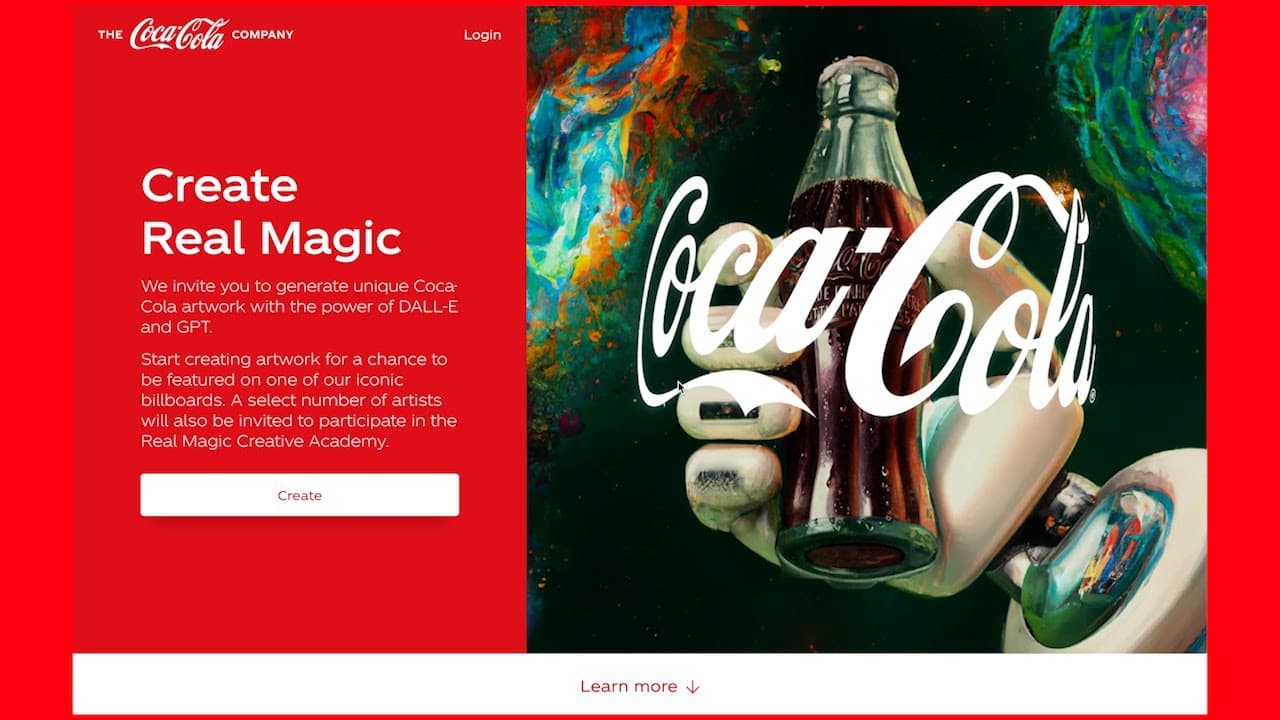
Coca-Cola ran “Create Real Magic” in March 2023 with OpenAI and Bain & Company. The public could generate artwork from the brand’s archive assets using GPT-4 and DALL-E, and winning pieces ran on billboards in Times Square and Piccadilly Circus. Coca-Cola’s own newsroom documents all of that. The revenue figure usually attached to the campaign is not documented anywhere, so we have left it out.
Coca-Cola’s AI remake of “Holidays Are Coming” ran in November 2024. Three AI studios made it (Secret Level, Silverside AI, Wild Card), the public reaction was hostile, and Coca-Cola made it again in November 2025. Pratik Thakar, the company’s Global VP and Head of Generative AI, put the value on execution rather than ideas: “AI is a superpower when it comes to execution and production, making what was previously impossible possible.” The Wall Street Journal reported roughly 100 people and more than 70,000 generated clips behind the 2025 version. Independent ad-testing firm System1 gave that 2025 ad its maximum 5.9 stars and credited creative consistency rather than the AI. System1 disclosed no sample size.

Toys “R” Us released “The Origin of Toys ‘R’ Us” in June 2024, the first brand film made with OpenAI’s Sora. Toys “R” Us Studios produced it with agency Native Foreign, it premiered at Cannes Lions, and it went from concept to final cut in a few weeks. The backlash was substantial. Comedy writer Mike Drucker, quoted by NBC News, put the objection sharply: “And to show how, we fired our artists and dried Lake Superior using a server farm to generate what that would look like in Stephen King’s nightmares.”

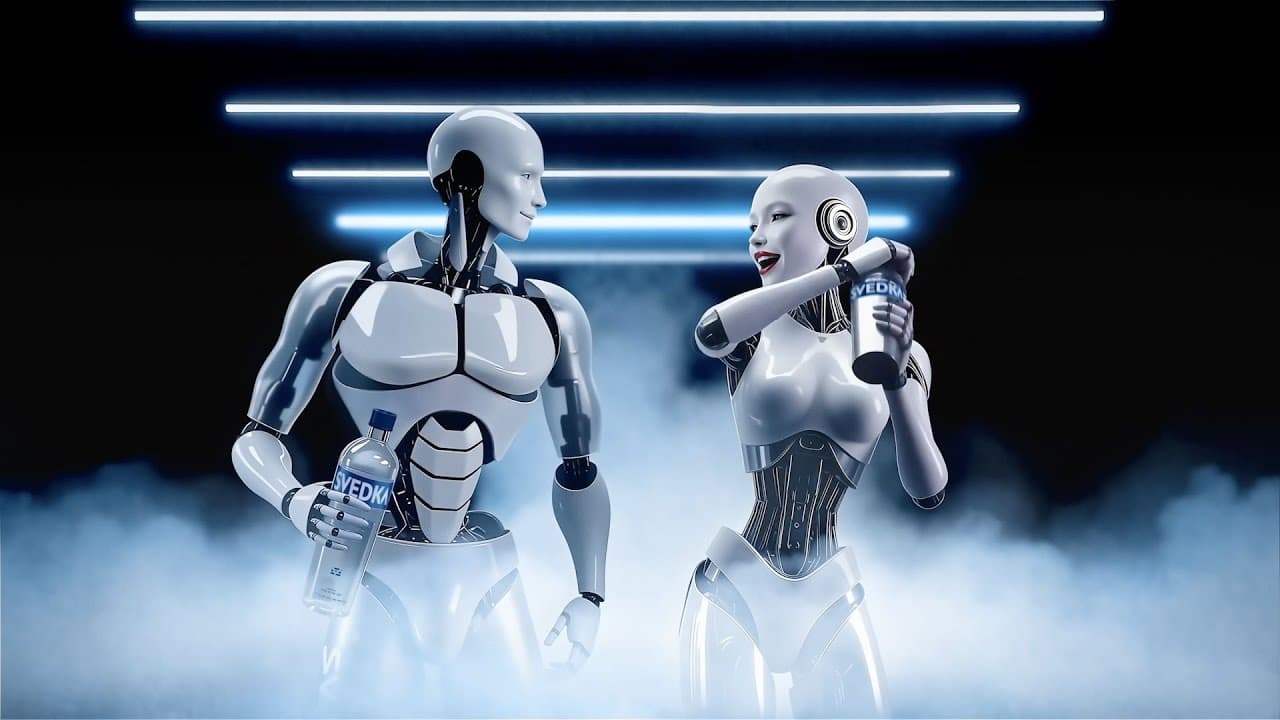
Svedka, owned by Sazerac, ran “Shake Your Bots Off” during Super Bowl LX on 8 February 2026. It was billed as the first primarily AI-generated national Super Bowl commercial, studio Silverside AI made it, and it revived a retired mascot whose original CGI files had been lost. The production timeline does not agree across sources: TechCrunch and Adweek reported about four months, while the vendor’s own case study says under one month. Adweek also ran a dissent arguing the ad proved AI is not an idea.
Kalshi ran a 30-second national spot during Game 3 of the NBA Finals in June 2025. One person made it, PJ Accetturo, using Google Veo 3, across roughly 300 to 400 generations, cut in two to three days, as covered by Ad Age. The budget figure attached to it is self-reported by the creator with no brand confirmation, and the “95% cost saving” version of the story has no baseline at all.

So generative tools can produce broadcast-grade assets quickly, and audiences frequently object. None of these campaigns shows that the ads sold anything.
Personalization at scale
Mondelez India ran “Not Just a Cadbury Ad” for Diwali 2020, with a second phase in October 2021. AI-generated video of Shah Rukh Khan was personalised so that each local shop’s name was spoken by the star, and it went out over WhatsApp. Ogilvy India, Wavemaker and Rephrase.ai built it, and it won a Titanium Lion at Cannes. Retailer counts vary wildly between sources, so take the mechanism as the lesson and ignore the totals.
Virgin Voyages ran “Jen AI” in 2024, using a licensed digital twin of Jennifer Lopez with generative voice and video lip-sync to produce personalised cruise invitations, through agency VML. The results are agency-reported and inconsistent between sources, so leave them aside. The design choice is worth copying: a visible effect appears whenever the AI puts words in Lopez’s mouth. The disclosure sits in the creative rather than the small print.
Automated media buying
Almost every article about AI in advertising is about creative. Almost all of the money is here. Google’s own documentation states that “Performance Max uses Google AI for bidding, budget optimization, audiences, creatives, attribution, and more,” and that with Final URL expansion on, “Google may replace your Final URL with a more relevant landing page based on the user’s search query, and generate a dynamic headline, description, and additional assets.” The system decides channel, placement, bid, budget split, audience and asset combination. Google publishes no performance number in that documentation.
One product carries two opposite consent models. Serve-time text customization is on by default. Google’s support documentation says plainly, “Note: Text customization is turned on by default”, serving only when predicted to outperform your uploaded assets and refreshed at least every 48 hours. Setup-time asset generation works the other way: “You’re always in control, and generating assets with Google AI is optional. If you skip the ‘Asset generation’ step, Google won’t prefill assets.” Same vendor, same campaign type, opposite defaults. A vendor makes a feature opt-in when it expects advertisers to say no.
There is also a number in wide circulation that belongs to the wrong product. Google AI Max for Search, announced in May 2025, claims “14% more conversions or conversion value at a similar CPA/ROAS,” rising to 27% for campaigns mostly using exact and phrase keywords. The footnote says Google internal data from 2025, covering non-Retail advertisers with more than 70% of conversions from exact or phrase match. Agency blogs routinely attribute that 27% to Performance Max. It is a different product and a narrow subset of advertisers.
Meta’s Advantage+ makes the same category of promise in its own marketing pages: “What used to take weeks of testing to find the right audience, budget and placement combinations is now an automated, end-to-end sales solution.” Meta has renamed “Advantage+ shopping campaigns” to “Advantage+ sales campaigns.” Its published CPA improvement figures carry footnote markers we could not read, so we are not repeating them. We also could not establish whether the Advantage+ levers are on by default. We are saying so rather than guessing.
Amazon is the one vendor publishing a method. Its DSP Performance+ documentation describes scoring “every bid opportunity in real-time” with predictions updated hourly, and simplifying “the typical 70-step campaign creation process.” The headline claim is “a 51% improvement in acquisition costs, compared to legacy Amazon DSP campaigns,” footnoted as internal Amazon data at 95% confidence. The measured quantity is the CPA Ratio: actual CPA at the end of a campaign divided by the campaign’s own target CPA. That is a claim about hitting the target you set, not about acquisition getting 51% cheaper, which is how it usually gets repeated. Amazon also launched Agentic Creative Studio on 17 September 2025, a conversational tool that “conducts product and audience research, brainstorms ideas, develops creative concepts in a storyboard format, and produces compelling video and display ads,” built on Amazon Bedrock including Amazon Nova and Anthropic Claude.
Automated buying is also where the volume of inventory keeps climbing, which puts its own pressure on what any single ad can do. We have written separately about why ad load is higher than ever.
Production pipelines
Klarna’s own newsroom said in May 2024 that “AI is responsible for 37% of the cost savings, or about $10 million on an annualized basis,” alongside a $6 million reduction in image production costs and an image development cycle cut “from 6 weeks to just 7 days,” using Midjourney, DALL-E, Firefly and Photoroom. The 37% attribution comes with no comparison group. It is Klarna’s claim, not a measured effect.
Unilever, working with Collective World on NVIDIA Omniverse, announced in March 2025 that photorealistic 3D digital twins of products were replacing physical shoots. Esi Eggleston Bracey, Chief Growth and Marketing Officer, said the technology “helped us create product imagery that’s two times faster, 50% cheaper.” No methodology or baseline was published, and NVIDIA sells the platform the claim promotes.
Both claims are about the marketing operation, not about the customer.
What the evidence shows
The strongest evidence in this field is one large randomized experiment. Ju and Aral, of Johns Hopkins and MIT Sloan, randomly assigned 2,234 participants to human-human or human-AI teams, produced 11,024 real ads, and ran them live on X for about 4.9 million impressions. Their working paper reports that “human-AI teams produced 50% more ads per worker and higher text quality, while human-human teams produced higher image quality, suggesting a jagged frontier of AI agent capability.” The performance side is much smaller than the marketing around this field suggests. Text quality “increased CTR by a small but statistically significant 0.007%,” while stronger image quality “significantly reduced CPC by $0.29 or 2.5%.” The productivity effect is 50%. The performance effect is 0.007%.
On automated buying, Haus analysed 640 Meta incrementality experiments in August 2025 and found that “Advantage+ performed 9% better than Manual campaigns at the experiment midpoint but 12% worse by the end of the experiment,” and that “58% of brands saw higher iROAS on Manual campaigns than Advantage+ in head-to-head tests.” Advantage+ over-reported its own effect by 12 percentage points. The average test ran 18.6 days, and the average advertiser in the sample spends $14M a year on Meta. Haus sells incrementality measurement, so it is third-party to Meta but not disinterested.
Two further studies complicate the creative side. In “AI in Disguise,” by Exner, Hartmann, Ding, Zhang and Netzer, published through the HBS AI Institute, a Taboola deployment covering more than 369 million impressions and 2.5 million clicks found that “AI-generated ads and human-made ads produced statistically indistinguishable click-through rates,” and that “AI-generated images achieve superhuman CTR levels only when they do not appear to be AI-generated.” Over 45% of the AI ads passed as human-made. Lee, Todri, Adamopoulos and Ghose, at NYU Stern and Emory, reported in November 2025 that fully AI-made ads increased CTR “by up to 19%” against human experts, while disclosing that an ad was AI-made caused a “31.5% decrease.” That one is an unrefereed working paper, and “up to 19%” is a ceiling rather than an average. Kapoor and Kumar, peer-reviewed in Marketing Science in 2025, ran a randomized field experiment on WhatsApp with an Indian D2C brand and found that “GenAI-based personalized video ads yield a 6 to 9 percentage point higher engagement rate, measured by ad clicks, than both baselines.”
Then there is the audience. Gallup published a probability-based survey on 19 August 2026, with 3,270 US adults fielded from 4 to 11 May 2026 and a margin of error of plus or minus 2.4 points. “Nearly half (49%) view businesses’ use of AI to create advertisements negatively, compared with 19% who view it positively.” The breakdown is more useful than the headline: 75% accept AI for brainstorming and early drafts, 53% accept AI creating final text, images or video, and 62% say synthetic people or voices are unacceptable. Among 18 to 29 year olds, 66% are negative. Consumers draw their line in roughly the same place the platforms draw theirs.
Marketers do not know this. The IAB study “The AI Ad Gap Widens,” covering 505 US Gen Z and Millennial consumers plus 104 US ad executives, found that “83% of ad executives now say their company has deployed AI in the creative process, up from 60% in the 2024 study.” It also found that 82% of executives believe those consumers feel positive about AI-generated ads, while 45% of the consumers do. Gartner, in March 2026, found that 50% of US consumers would prefer to give their business to brands that do not use generative AI in consumer-facing content, from a sample of 1,539 fielded in October 2025.
The ads that went wrong
McDonald’s Netherlands is the cleanest withdrawal case. In December 2025 it released a fully AI-generated Christmas ad, “It’s the Most Terrible Time of the Year,” with TBWA\Neboko, and made it private on YouTube after about three days. The brand’s statement, reported by The Drum on 11 December 2025, said: “we have decided to remove our AI-generated Christmas advert… we recognize that for many of our guests, the season is ‘the most wonderful time of the year’.”
The Advertising Standards Authority provides the cleanest regulator case. On 25 March 2026 it upheld a complaint from 22 complainants about a paid Meta ad for a robot-dog toy by UAB CommerceCore, trading as WiggyDog. The ruling reads: “We considered that the scenes in the video in the ad, which appeared to be of real and/or AI-generated puppies, also gave the impression that the product was highly realistic and lifelike. WiggyDog provided no evidence regarding the functionality and appearance of the toy.” The ruling turned on the missing evidence for the product claim, not on the use of AI.
Guess ran AI-generated models by Seraphinne Vallora in the August 2025 issue of American Vogue, disclosed only in small print, and calls for a boycott followed. The campaign was not pulled and no apology was issued. Worth stating plainly, because the story is often retold as a withdrawal.
Under Armour and Anthony Joshua produced an inverted failure in March 2024. A spot promoted as the world’s first AI-powered sports commercial turned out to be largely a repackaging of existing human-shot footage, with the original director and cinematographer uncredited until industry pressure forced credits to be added. The failure there was claiming AI did work that humans did.
At Cannes Lions 2025, DM9’s Creative Data Grand Prix was withdrawn after Cannes found that the case study used AI-generated and manipulated content to simulate real events and outcomes. Two further entries were withdrawn. Award case studies are not evidence.
Enforcement is real, if narrow. The FTC’s Operation AI Comply in September 2024 brought five actions. The advertising-relevant one was against Rytr, whose review generator could produce unlimited fake consumer reviews. Chair Lina M. Khan said: “Using AI tools to trick, mislead, or defraud people is illegal… there is no AI exemption from the laws on the books.” Google’s April 2025 Ads Safety Report says more than 700,000 advertiser accounts were permanently suspended over AI-generated public-figure impersonation ads, followed by a “90% drop in reports of this kind of scam ad.” That is Google reporting on Google.
How to check a claim
Run this on the next deck you are shown.
- Which of the four is it? A production speed-up is not a performance result, and neither is an award.
- Who measured it? Almost every headline number in this field comes from the party selling the capability. That is not automatically wrong, and it is never enough on its own.
- Read the footnote, not the headline. Amazon’s 51% is a ratio against the advertiser’s own target. Google’s 27% belongs to AI Max for Search and to a narrow subset of campaigns.
- Is there a comparison group? Klarna’s 37% has none. Ju and Aral randomly assigned 2,234 people. Those are not the same kind of claim.
- Does the number have a denominator and a date? System1 published a score with no sample size. Gallup published n, field dates and a margin of error.
- Does the vendor measure itself? Haus found Advantage+ over-reporting its own effect by 12 percentage points. A platform will not catch that in its own dashboard.
- What does the default tell you? When a vendor turns one feature on by default and makes the adjacent one opt-in, it has already told you which one it expects you to refuse.
That last point is not really about advertising. The party being measured picks the defaults and picks the metrics it reports, which is also why so much agency reporting looks healthy while pipeline does not. We have written about why marketing agencies optimize the wrong KPIs.
How Pressfit approaches this
Pressfit.ai does not sell an autonomous advertising product, and nothing in this post should be read as a claim that we have one.
Our paid media work covers behavioral channel and creative selection, competitor gap analysis on paid, bid management and conversion tracking, programmatic ad buying, and performance reporting with AI insight. It is built on behavioral signals rather than platform-reported metrics for the reason the Haus finding shows: a system that grades its own homework grades it generously. The underlying idea is set out in our explanation of behavioral intelligence.
Our content gap analysis answers a related question the same way. It names the categories where advertising reaches the audience better than publishing would, with cost-per-click and competition data attached, so the decision to buy attention rather than earn it is made against numbers rather than a hunch.
Checking whether a number means what it appears to mean is the work. If a vendor has shown you a figure you cannot trace, tell us what it says and we will show you how we would check it.
FAQ
What is an AI advertising campaign?
The label covers four different things: generative creative, where a model makes the image, video or copy; personalization at scale, where one idea is rendered into many addressed versions; automated media buying, where a model chooses channel, placement, bid, budget and audience; and production pipelines, where AI replaces photo shoots and asset production inside the marketing operation. Most of the confusion in this field comes from a claim about one being presented as proof about another.
Do AI-generated ads actually perform better?
The strongest evidence says barely. In a randomized experiment by Ju and Aral, 2,234 participants produced 11,024 real ads run live on X across about 4.9 million impressions. Human-AI teams produced 50% more ads per worker, but higher text quality raised click-through rate by 0.007%, and stronger image quality reduced cost per click by $0.29, or 2.5%. A separate Taboola study covering more than 369 million impressions found AI-generated and human-made ads produced statistically indistinguishable click-through rates.
Which companies have run real AI advertising campaigns?
Documented examples include Coca-Cola with Create Real Magic in 2023 and the AI remakes of Holidays Are Coming in 2024 and 2025, Toys R Us with OpenAI's Sora in June 2024, Svedka's Super Bowl LX spot in February 2026, Kalshi's NBA Finals spot in June 2025, Cadbury's Not Just a Cadbury Ad in India, Virgin Voyages' Jen AI, and production-side programs at Klarna and Unilever. Automated media buying at Google, Meta and Amazon is a far larger share of real AI advertising spend and gets discussed far less.
How do consumers feel about AI-generated ads?
Gallup surveyed 3,270 US adults from 4 to 11 May 2026 with a margin of error of plus or minus 2.4 points. 49% view businesses' use of AI to create advertisements negatively against 19% positively, and the breakdown is more useful than the headline: 75% accept AI for brainstorming and early drafts, 53% accept AI creating finished text, images or video, and 62% say synthetic people or voices are unacceptable. IAB found 82% of ad executives believe young consumers feel positive about AI-generated ads, while 45% of those consumers do.
How should I check a vendor's AI advertising performance claim?
Ask which of the four categories the claim belongs to, who measured it, and what the footnote says rather than the headline. Amazon's 51% acquisition-cost claim is a ratio of actual cost per acquisition to the advertiser's own target. The 27% conversion figure often shown next to Performance Max belongs to Google AI Max for Search and to a narrow subset of campaigns. Then ask whether there is a comparison group, a sample size and a field date, and whether the party reporting the result is the party being measured.